
Tunisia's 2025-2026 Olive Oil Season: Harvest and Trends
Published on July 6, 2026 · Updated on July 12, 2026 · 7 min
By the Virginia trading team · reviewed by Tarek Neffati, president
In Tunisia, the olive harvest runs from October to January, the first oils of the season are available as early as November, and bulk prices are formed on a Mediterranean balance in which Spain sets the tempo. No one can seriously predict a season's quotations; the mechanics that produce them, however, are stable and can be understood in one read. Those mechanics determine when to buy, under what contractual form, and at what premium level.
The 2025-2026 season in figures
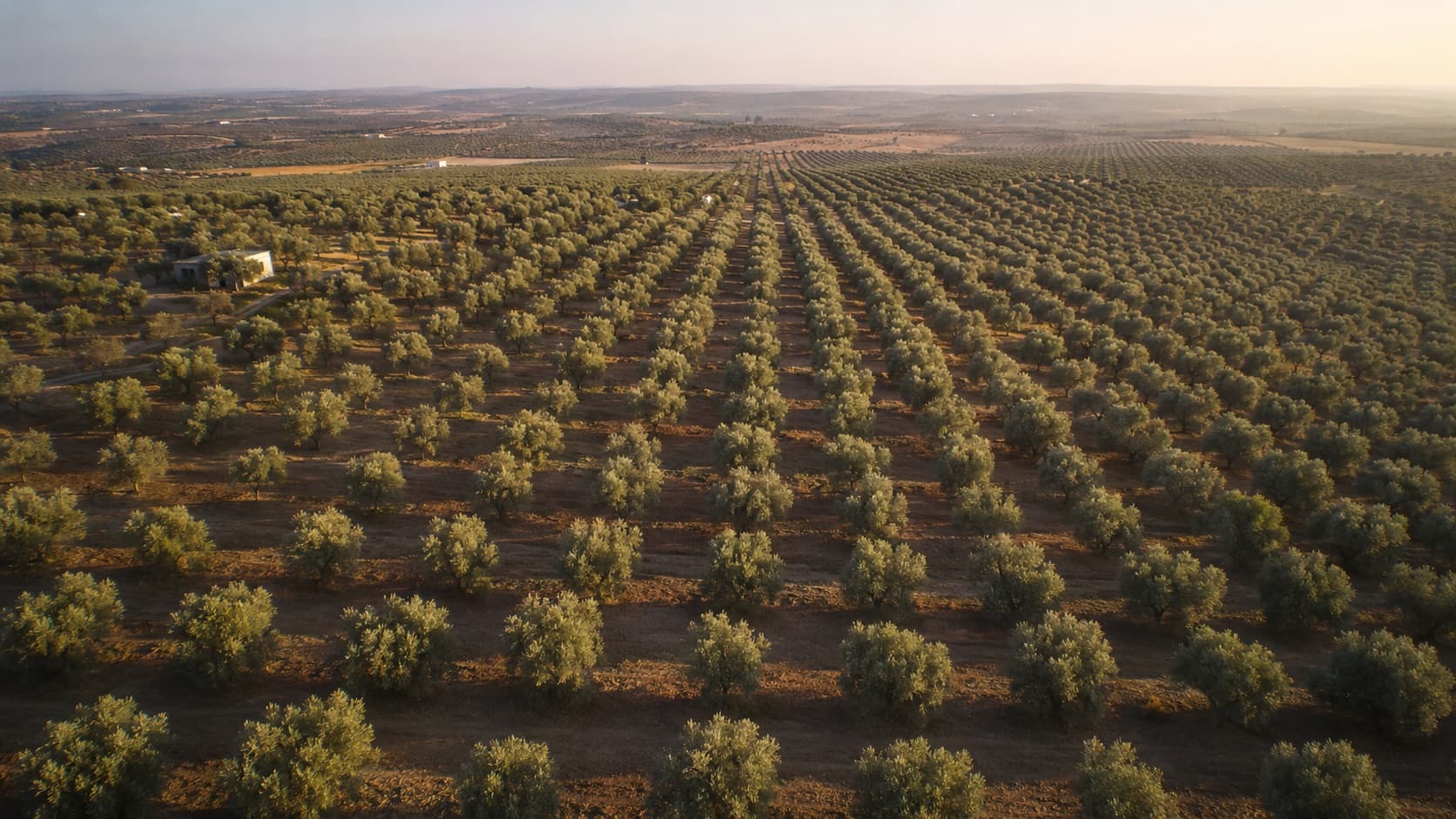
The 2025-2026 campaign will be remembered as one of the most abundant in the origin's history. The International Olive Council (IOC) and the Tunisian industry put production between 450,000 and 500,000 tonnes — beyond the previous record of 2019/20 — a level that makes Tunisia the season's second-largest producer in the world, behind a Spain back at around 1.4 million tonnes.
Exports followed suit. According to the agricultural observatory ONAGRI, Tunisia shipped 327,400 tonnes over the first seven months of the campaign (November-May), up 57.9% year on year, for more than 4 billion dinars in receipts (up 44.9%). Extra virgin accounts for roughly 83% of exported volume, and Spain established itself as the origin's largest customer — around a third of volumes — ahead of Italy and the United States: Iberian bottlers drew heavily on Tunisian supply to rebuild their stocks.
What this record season means for buyers
- Softer quotations. Mediterranean abundance pulled prices well down from the 2023-2024 peaks: Tunisian receipts grew more slowly than volumes, a sign the balance of power shifted back towards the buyer.
- Deep supply, late into the campaign. With record availability, fine lots did not grow scarce as fast as usual: mid- and late-season buying windows stayed better stocked.
- One caution: alternate bearing. A rain-fed orchard that has just produced a record is statistically more likely to pause the following season — a parameter to build into 2026-2027 contracts now.
The signals to watch for 2026-2027
- The first Spanish crop estimates, published in September-October: they steer the whole basin.
- The IOC's production and trade balances, and the weekly prices consolidated by the European Commission's market observatory.
- Summer and autumn rainfall over the Tunisian orchard: after a record year, it will decide how sharp the counter-swing is.
That is the backdrop. The rest of this article walks through the permanent mechanics — calendar, premiums, contractual forms — that turn this snapshot into buying decisions.
The calendar of a Tunisian olive season
October-November: first olives, first oils
Picking starts in the earliest orchards. Olives harvested early, still turning color, yield green-fruity oils: intense, rich in polyphenols, with lower oil yields. These early-season lots are the most sought after by premium buyers and move fast. It is also when positions are taken: the first milled volumes give an idea of the year's quality, and sellers and buyers alike begin locking in commitments.
December-January: the heart of the season
Milling runs at full capacity across the country. This is the period of greatest availability: supply is broad, profiles are varied, and the buyer can compare lots from several mills on samples and analysis certificates. For significant volumes against precise specifications, it is the best window to secure quality at the right price.
February through summer: selling from stocks
The harvest is over; sales now run from stocks. Well-stored oils — stainless steel tanks, nitrogen blanketing, controlled temperatures — keep their qualities, but the best lots grow scarcer as the season advances. Late buyers choose from a narrower offering, and quality premiums reflect it.
| Period | Stage | What it means for the buyer |
|---|---|---|
| October-November | Harvest begins, green fruitiness | Book premium lots early, first quality signals |
| December-January | Full milling | Maximum availability, best contracting window |
| February-April | Sales from stocks | Supply still broad, watch storage conditions |
| May-September | End of season | Limited choice, demand recent analyses on every lot |
The 2025-2026 season followed this script to the letter: first green-fruity oils from November, record milling in December-January, then an unusually well-stocked period of sales from stocks in spring. Buyers who took positions early captured the best premiums on early-harvest lots; those who waited found — a rare thing — supply still broad in April-May, a direct consequence of the record availability.
How bulk prices are formed
The Mediterranean balance
The price of olive oil is global, but it is made in the Mediterranean. Spain, by far the largest producer, sets the reference: a big Spanish crop eases every origin, a small one pulls them all upward. Around that pivot, the Tunisian, Greek, Turkish and Portuguese crops, the natural alternate bearing of the orchards and weather events adjust the equation. Demand plays the other side: bottlers' needs, stock rebuilding, and consumer-market behavior when prices climb.
The practical consequence: tracking the Tunisian origin alone is not enough. A shrewd buyer watches the Spanish crop estimates in the fall, because they steer the market before the Tunisian season even delivers its volumes.
The quality premium
On any given date, not all lots are worth the same price. The spreads follow a stable hierarchy:
- Grade and acidity: extra virgin trades above virgin and lampante oils, and within extra virgin, low acidities command a premium.
- Sensory profile: a clean, defect-free green fruitiness is worth more than a flat profile.
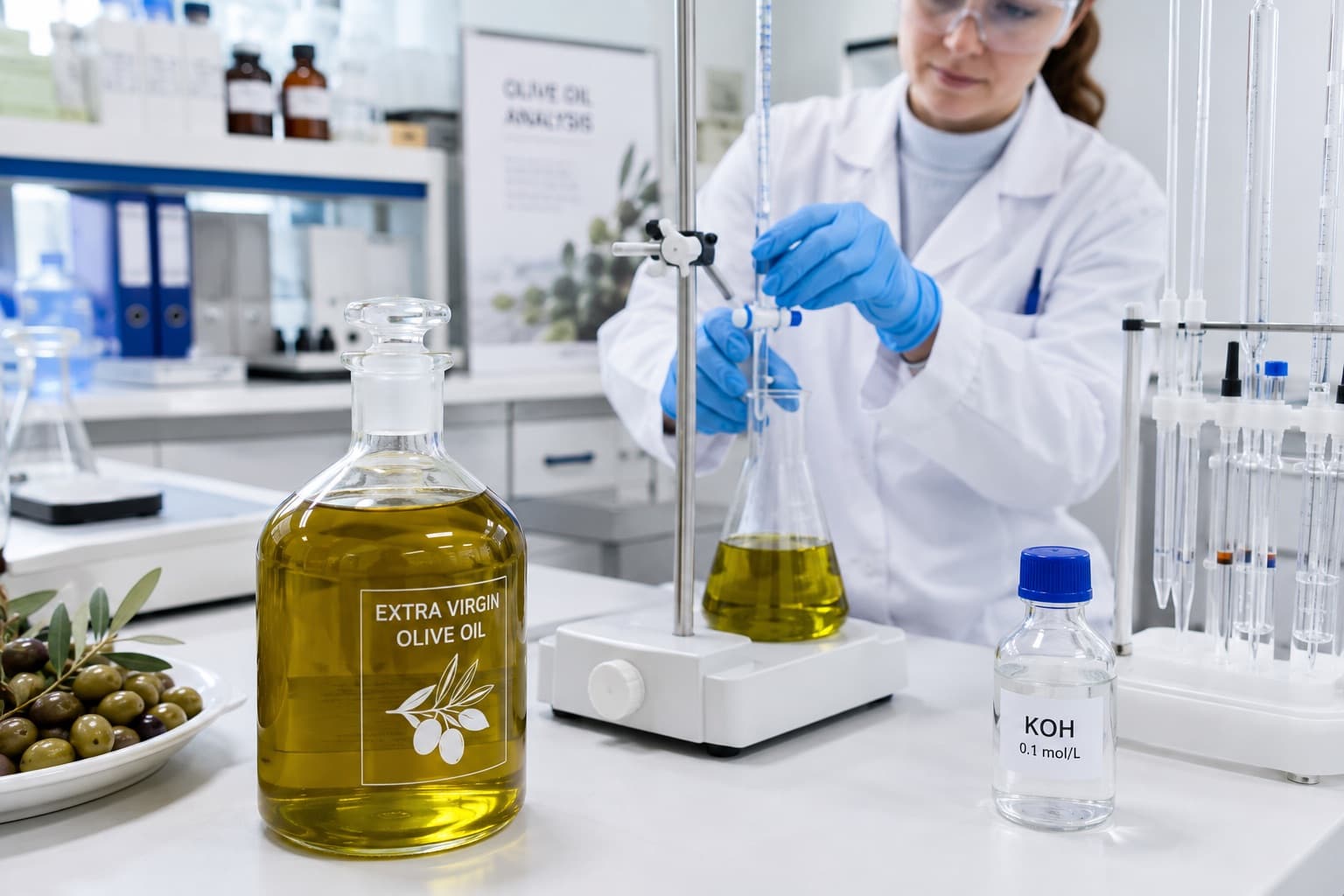
- Polyphenols and analytical freshness: peroxide and UV absorbances well clear of the limits justify a premium, because they guarantee the lot will hold up over time — hence the importance of knowing how to read a COA.
- Certification: organic systematically trades above conventional, and Tunisia is one of the best-positioned origins in that segment.
Spot or season contract
A spot purchase — one lot, one price, one shipment — offers maximum flexibility: you seize an opportunity and adjust volumes to actual needs. Its downside is full exposure to price moves and to the risk of non-availability late in the season.
The season contract reverses the logic: volumes reserved over several months, staggered shipments, price fixed at signing or indexed with pricing windows. The buyer secures availability and smooths their average price; the seller secures an outlet. In practice, industrial buyers combine the two: a contracted base for firm requirements, plus a spot complement for fine-tuning.
Incoterms: compare comparable prices
A bulk price means nothing without its incoterm. Between an ex-mill price (EXW), FOB Tunisian port, CIF European port and delivered-at-place (DAP), the gap covers pre-carriage, freight, insurance and customs clearance. Two offers can only be compared once brought back to landed cost per ton at your site, logistics format included — flexitank, isotank, drums or IBCs. That is exactly the calculation our calculators are built for.
Securing your supply: the method
- Qualify the origin before the season: samples, certificates, a visit or documentary audit of partner mills.
- Take positions early on firm requirements, under a season contract with staggered shipments.
- Demand the COA for every lot before loading, with a jointly sealed sample and a counter-analysis clause.
- Keep a spot share to adjust volumes and seize mid-season opportunities.
- Think in landed cost, incoterm and logistics included — never in ex-works price alone.
Plan the season with Virginia
The market picture changes every season; the way we quote does not: real lots from the current campaign, sourced from our partner mills — more than 30,000 tons a year — each backed by its analysis certificate. Whether you want to contract your 2026-2027 volumes before the alternate-bearing swing or seize a late-season spot opportunity, request a quote: we answer within 24 business hours, samples included, with every format covered by our bulk offer.
Read next
MarketGuides
Bulk Olive Oil for Nutraceuticals and Softgels
Olive oil as a softgel carrier oil and nutraceutical ingredient: Ph. Eur., USP-NF, oxidative stability, specs and bulk sourcing for encapsulators.
September 2, 2026 · 7 min read
Market
Olive Oil 2026/27 Season: Early Signals on Price and Supply
Tunisia's 2025/26 export campaign closes at record volumes while Spain and Italy send mixed early signals for 2026/27 — what bulk buyers should do before autumn.
August 26, 2026 · 7 min read

Tell us what you need.
Volume, grade, packaging, destination: describe your project and we'll get back to you within one business day with an offer at the best price — or the right questions.