
How to Read an Olive Oil COA: Acidity, Peroxide, K232, K270
Published on July 6, 2026 · Updated on July 12, 2026 · 7 min
By the Virginia trading team · reviewed by Tarek Neffati, president
A certificate of analysis — the COA — fits on a single page, and that page tells you almost everything: the oil's actual grade, its oxidation status and its ability to survive transport and storage. Four families of parameters carry most of the weight: free acidity, peroxide value, UV absorbances (K232, K270, ΔK) and, increasingly, polyphenols. A professional buyer needs to read them without an intermediary — and above all, demand this document before any commitment, not after.
Why demand the COA before committing
The COA is the chemical snapshot of a specific lot on a specific date. Ordering on the strength of an "extra virgin" label without a certificate means buying a promise; ordering with the lot's COA means buying verifiable, enforceable facts. The right reflex: sealed sample, analysis, then a contract that references the certificate's values as contractual specifications. If a supplier balks at providing the lot's COA before signature, that refusal is information in itself.
Free acidity: the grade criterion
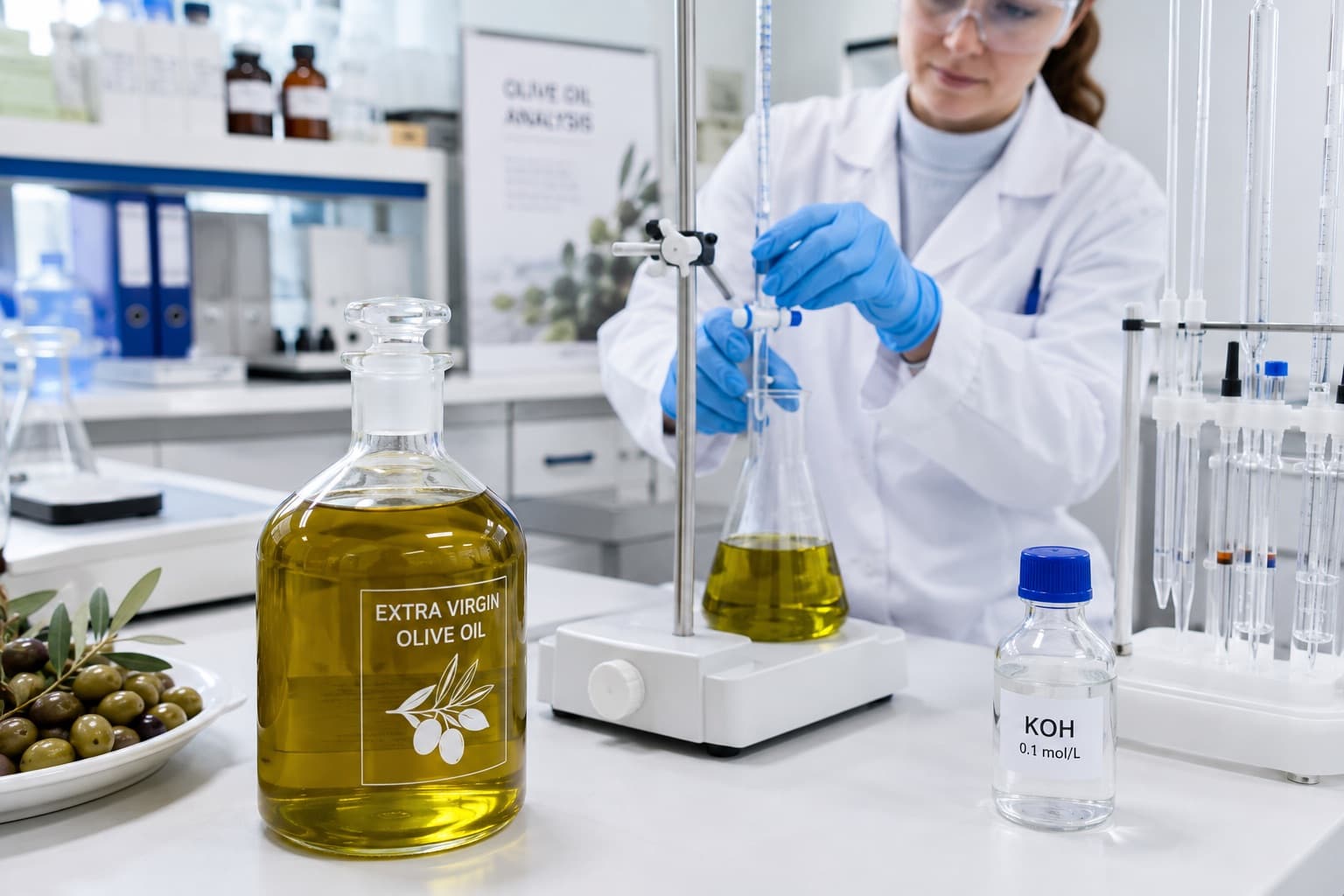
Free acidity measures the proportion of free fatty acids, expressed as a percentage of oleic acid. The standard is simple: an extra virgin olive oil must test at no more than 0.8%. Low acidity reflects healthy olives, harvested and milled quickly; rising acidity signals damaged or fermented fruit, or an excessive delay between harvest and extraction.
Beware of the opposite reflex: acidity alone does not make a great oil. It is the entry criterion for the grade, not a certificate of overall quality. An oil can show 0.3% acidity and still carry a sensory defect that downgrades it.
Peroxide value: primary oxidation
The peroxide value quantifies the primary products of oxidation, in milliequivalents of active oxygen per kilogram. The extra virgin limit is 20 meq O₂/kg. A fresh, well-handled oil sits well below that ceiling; a value approaching it indicates an oil already attacked by oxygen, light or heat, with a short remaining shelf life.
For a buyer, this number is predictive: it tells you how the lot will withstand transport, storage and its commercial shelf life. Between two lots at the same price, the peroxide spread is often the deciding argument.
K232, K270 and ΔK: the UV revealers
UV spectrophotometry measures the oil's absorbance at specific wavelengths. For extra virgin, the limits are: K232 ≤ 2.50, K270 ≤ 0.22 and ΔK ≤ 0.01.
- K232 reflects primary oxidation, complementing the peroxide value.
- K270 reveals secondary — more advanced — oxidation and the possible presence of refined oils.
- ΔK is the anti-fraud parameter par excellence: an abnormal value betrays blending with refined or deodorized oil.
It is this trio that separates a genuinely virgin oil from a disguised blend. A COA without the UV absorbances is an incomplete COA: acidity and peroxide can both look excellent on an adulterated oil.
Polyphenols: freshness and positioning
Polyphenols are not a grade criterion, but they have become a buying argument. They are natural antioxidants: they protect the oil over time and carry the bitterness and pungency characteristic of green-fruity profiles. Oils from the Chetoui variety, typical of northern Tunisia, are naturally rich in them. For buyers targeting the European health claim on polyphenols, the regulatory threshold is expressed in hydroxytyrosol and its derivatives; in that case, require the assay on the certificate, with the method specified.
The benchmarks to memorize
| Parameter | Extra virgin limit | What it reveals |
|---|---|---|
| Free acidity | ≤ 0.8% (oleic acid) | Fruit health, speed of milling |
| Peroxide value | ≤ 20 meq O₂/kg | Primary oxidation, remaining shelf life |
| K232 | ≤ 2.50 | Primary oxidation (UV) |
| K270 | ≤ 0.22 | Secondary oxidation, refined oils |
| ΔK | ≤ 0.01 | Adulteration detection |
| Panel test | Defects = 0, fruitiness > 0 | Sensory conformity of the grade |
The panel test completes the chemistry: to qualify as extra virgin, an oil must show a median of defects equal to zero and a median of fruitiness above zero, assessed by a standardized tasting panel.
What should raise a red flag
- Values hugging the limits. A lot at 0.7% acidity and a peroxide value of 18 is technically extra virgin, but has no margin left for transport and storage.
- A "typical" or undated COA. The certificate must carry the lot number, the analysis date and the laboratory's identity. A generic document protects you from nothing.
- Missing parameters. No UV absorbances or no panel test: request the missing data before moving forward.
- An unknown laboratory. Favor accredited laboratories (ISO 17025) or those recognized by the International Olive Council.
- An old analysis date. Oil evolves; an early-season certificate no longer describes the same product ten months later.
Reading a borderline COA: a worked example
Take a real end-of-season certificate: acidity 0.6%, peroxide value 17 meq O₂/kg, K232 at 2.45, K270 at 0.20, ΔK at 0.008, polyphenols 210 mg/kg, panel test compliant. On paper everything is within limits: the lot is genuinely extra virgin. Yet an experienced buyer reads it differently. The clean ΔK and the compliant panel rule out fraud and sensory defect: the oil is real and sound. But the acidity and, above all, the peroxide — both close to the ceiling — point to a raw material already pushed hard and to advanced oxidation. In practice there is little margin left: after two months of transit and six months on the shelf, the peroxide will almost certainly cross the 20 limit, and the lot will no longer be extra virgin by its best-before date. The high K232 confirms that trajectory. Set against a neighbouring lot at the same price showing 0.3% acidity, a peroxide of 8 and K232 at 2.1, the choice is settled — not because the first is non-compliant, but because it will not stay compliant. Reading a COA means projecting these numbers forward in time, not just ticking them off.
Internal lab or accredited laboratory: the question that changes everything
Not all certificates are equal, because not all laboratories are equal. A mill can analyse its own oils in its in-house lab: useful for day-to-day control, but such a certificate is judge and party, with no formal recognition. An ISO/IEC 17025-accredited laboratory, by contrast, is audited by a national body on its technical competence, its methods and its measurement uncertainty; some are additionally recognised by the IOC for sensory analysis. The gap in evidentiary weight between the two is considerable, above all in a dispute.
Before accepting a COA, put a few precise questions to the laboratory — not just the seller:
- Does the ISO 17025 accreditation cover exactly the parameters on the certificate, or only some of them? (The scope of accreditation is public and verifiable.)
- Which standardised methods were applied (IOC or EU references) for each analysis?
- What is the measurement uncertainty on peroxide and acidity? A "19.5" with an uncertainty of ±2 is not reassuring near the 20 limit.
- Does the panel test come from a recognised jury, and is its report tied to the same lot number?
A COA from an accredited laboratory, carrying the lot number and named methods, is worth infinitely more than a "typical" certificate from an in-house lab. It is this requirement that separates a decorative document from a contractual instrument.
The questions to ask your supplier
- Does this COA match the exact lot that will be loaded, and will the lot number appear on the shipping documents?
- Was the sample drawn and sealed jointly, in the presence of both parties, before loading?
- Does the contract provide for a counter-analysis at destination, and under what procedure in case of a discrepancy?
- Was the panel test performed, and by which panel?
- What are the lot's storage conditions between analysis and shipment (stainless steel, inert gas blanketing, temperature)?
A serious supplier answers these five questions without hedging. It is the standard we hold ourselves to: every lot shipped by Virginia leaves with its COA, as part of our quality program.
From the certificate to the buying decision
A COA is only worth the decision it enables: keep a lot, reject another, or renegotiate a specification before you sign. The method comes down to three moves — sealed sample, cross-reading of the parameters over time, contract that takes up the certificate's values. Request samples of our analyzed Tunisian oils to practise on real certificates, request a quote on the lot that holds your specification, or place these analyses back in their supply chain with our guide to Tunisian olive oil.
Read next
QualityLogistics
Bulk Olive Oil Sampling Protocol: ISO 5555 & IOC Method
ISO 5555, the IOC's 10/30/10 tank method, sealed counter-samples: the sampling protocol every buyer should demand before any bulk olive oil purchase.
October 2, 2026 · 7 min read
Quality
Cold-Extracted Olive Oil: Why the Decanter Matters
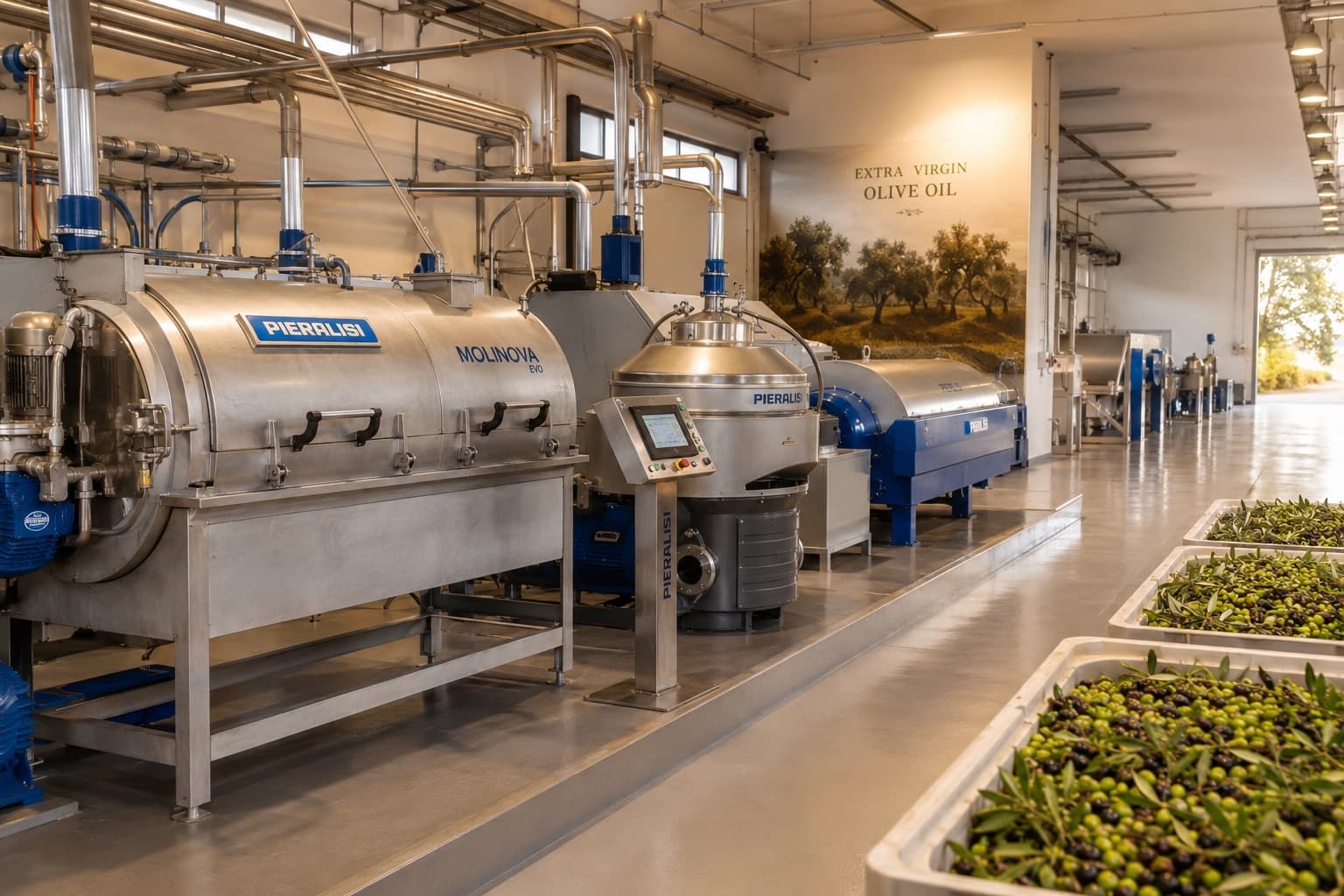
Two-phase or three-phase decanter, malaxation temperature: what actually separates a genuinely cold-extracted olive oil from the rest of the label claims.
August 31, 2026 · 7 min read
Tell us what you need.
Volume, grade, packaging, destination: describe your project and we'll get back to you within one business day with an offer at the best price — or the right questions.